

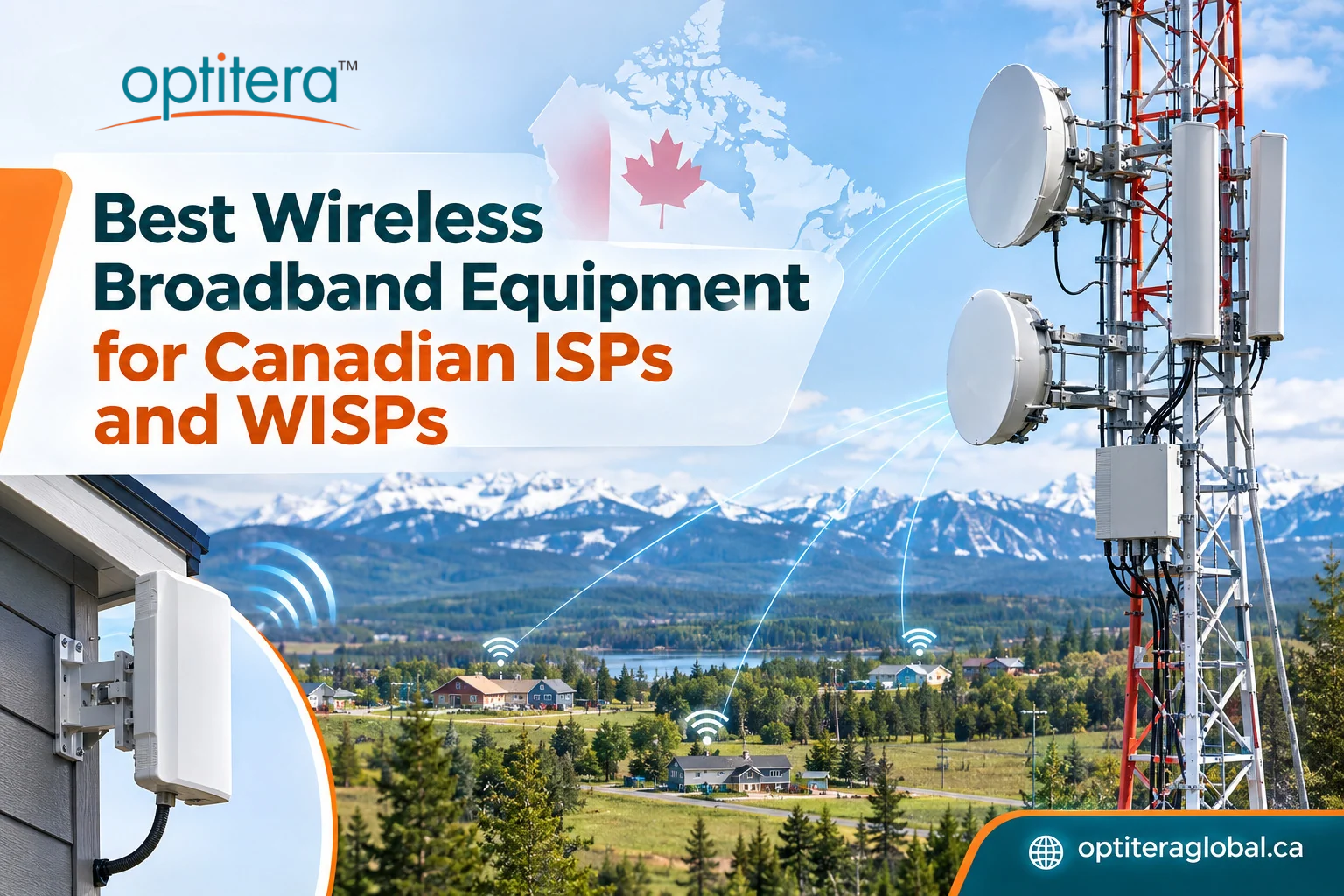
Reliable internet connectivity has become essential for businesses, residential communities, and remote locations across Canada. As demand for high-speed internet continues to grow, Internet Service Providers (ISPs) and Wireless Internet Service Providers (WISPs) need dependable wireless broadband infrastructure to deliver consistent connectivity to their customers.
However, expanding broadband coverage is not just about installing wireless radios. It requires the right combination of point-to-point (PtP) radios, point-to-multipoint (PtMP) access points, customer premises equipment (CPE), high-performance antennas, routers, and network accessories.
For Canadian ISPs and WISPs, selecting the right wireless broadband equipment can improve network capacity, coverage, reliability, and long-term scalability.
In this guide, we explore the best types of wireless broadband equipment, leading networking brands, essential selection factors, and solutions that can help Canadian internet service providers build stronger networks.
1. What Is Wireless Broadband Equipment?
Wireless broadband equipment refers to the hardware used to establish and distribute high-speed internet connectivity without requiring a physical wired connection to every customer location. These solutions use radio frequencies to transmit data between network infrastructure and subscriber devices.
Wireless broadband technology is particularly useful in areas where installing fibre infrastructure may be expensive, time-consuming, or geographically challenging.
For ISPs and WISPs, wireless broadband equipment can support:
- Rural and remote internet connectivity.
- Last-mile broadband distribution.
- Point-to-point wireless backhaul.
- Point-to-multipoint subscriber connectivity.
- Business and enterprise internet services.
- Temporary and expanding network deployments.
- Connectivity across geographically challenging locations.
By combining the right wireless radios, antennas, routers, and switching equipment, service providers can develop scalable broadband infrastructure.
2. Essential Wireless Broadband Equipment for ISPs and WISPs
Building a reliable wireless network requires several interconnected components. Each component performs a specific function in delivering internet connectivity.
A. Point-to-Point (PtP) Wireless Radios
Point-to-point wireless radios establish dedicated wireless connections between two locations. They are commonly used to connect communication towers, network distribution sites, internet service provider facilities, remote buildings, and wireless backhaul locations.
PtP equipment is particularly important for WISPs that need to transport internet traffic from a central network location to remote distribution points.
When selecting PtP wireless radios, consider:
- Maximum throughput.
- Operating frequency.
- Link distance.
- Antenna gain.
- Channel bandwidth.
- Latency.
- Line-of-sight requirements.
- Environmental protection rating.
A properly designed PtP link can provide reliable backhaul connectivity without requiring fibre cables between every location.
B. Point-to-Multipoint (PtMP) Access Points
Point-to-multipoint technology allows a central access point to communicate with multiple subscriber devices. Instead of establishing an individual backhaul link for every customer, WISPs can distribute connectivity from a strategically positioned access point to multiple CPE devices.
Common applications include:
- Residential broadband distribution.
- Rural internet connectivity.
- Small-town broadband infrastructure.
- Business park connectivity.
- Remote community internet services.
Important features to evaluate include sector capacity, subscriber density, supported frequency bands, channel bandwidth, interference management, and compatible subscriber equipment.
C. Customer Premises Equipment (CPE)
Customer premises equipment is installed at the subscriber’s location to receive wireless broadband signals from the provider’s network. CPE devices are essential for connecting homes, offices, commercial buildings, and remote properties to a WISP network.
When choosing CPE equipment, evaluate:
- Wireless standards and compatibility.
- Signal reception capabilities.
- Antenna gain.
- Supported frequencies.
- Ethernet interface speed.
- Weather resistance.
- Installation flexibility.
Selecting compatible CPE devices helps maintain consistent network performance across the subscriber base.
D. High-Gain Wireless Antennas
Antennas play an important role in wireless broadband performance, particularly in long-distance connections and outdoor deployments. High-gain antennas can help focus radio energy in a particular direction, improving link performance when properly selected and aligned.
Common antenna types include:
- Dish antennas.
- Sector antennas.
- Panel antennas.
- Horn antennas.
- Integrated antennas.
The correct antenna depends on link distance, frequency, coverage requirements, signal conditions, and the radio’s compatibility.
E. Routers and Network Switches
Wireless radios establish connectivity, but routers and switches help manage and distribute network traffic. ISPs and WISPs require suitable routing and switching infrastructure to manage subscribers, connect network segments, and maintain reliable operations.
Important features include:
- VLAN support.
- Routing capabilities.
- Firewall functionality.
- Bandwidth management.
- Gigabit and multi-gigabit Ethernet.
- SFP and SFP+ uplinks.
- Power over Ethernet (PoE).
- Network monitoring.
Combining wireless broadband equipment with appropriate routing and switching hardware creates a more complete network infrastructure.
3. Top Wireless Broadband Brands for Canadian ISPs and WISPs
Several networking manufacturers offer equipment designed for wireless broadband, backhaul, and internet distribution. Let’s explore some of the important brands available through Optitera Global.
1. Mimosa Networks – High-Performance Wireless Broadband
Mimosa Networks offers fixed wireless broadband solutions designed for ISPs and WISPs that require high-capacity connectivity, wireless backhaul, and last-mile broadband distribution. Its product portfolio includes PtP radios, PtMP access points, subscriber devices, and antennas.
Mimosa B6x
The Mimosa B6x is an outdoor point-to-point backhaul radio designed for high-capacity wireless links. It supports 5 GHz and 6 GHz operation, with advertised wireless throughput capabilities of up to 3.14 Gbps, depending on operating conditions and configuration.
Key highlights:
- Outdoor PtP backhaul radio.
- 5 GHz and 6 GHz support.
- Wi-Fi 6E technology.
- Low-latency connectivity.
- IP67-rated enclosure.
- Compatible with selected external antennas.
Mimosa C5x
The Mimosa C5x is a versatile outdoor wireless radio designed for PtP and PtMP applications.
Key highlights:
- 5 GHz wireless connectivity.
- Modular antenna compatibility.
- Outdoor IP67-rated enclosure.
- Support for PtP and PtMP operating modes.
- Flexible deployment options.
Mimosa A6
The Mimosa A6 is a point-to-multipoint access point designed for high-capacity fixed wireless broadband networks. It supports 8×8 MU-MIMO and OFDMA technology, making it suitable for service providers planning high-capacity subscriber distribution.
Why Choose Mimosa?
Mimosa is worth considering for WISPs looking to expand wireless broadband coverage, build high-capacity backhaul links, and improve last-mile connectivity.
Explore Mimosa networking products at Optitera Global.
2. Cambium Networks – Scalable Broadband Infrastructure
Cambium Networks provides wireless broadband and enterprise networking solutions for service providers, businesses, and organizations. Its portfolio includes fixed wireless access solutions, point-to-point connectivity, point-to-multipoint systems, and networking infrastructure.
Cambium’s wireless solutions can support applications such as:
- Rural broadband deployment.
- Outdoor wireless connectivity.
- Enterprise connectivity.
- Wireless backhaul.
- Multi-site network infrastructure.
When selecting Cambium equipment, service providers should evaluate the supported product family, operating frequencies, subscriber capacity, network management requirements, and compatibility with existing infrastructure.
Why Choose Cambium Networks?
Cambium is worth evaluating for ISPs and WISPs looking for scalable fixed wireless broadband infrastructure and solutions designed for service-provider deployments.
Explore Cambium Networks products at Optitera Global.
3. MikroTik – Flexible Routing and Wireless Networking
MikroTik is known for its RouterOS platform, networking hardware, wireless products, and advanced configuration capabilities. For ISPs and WISPs, MikroTik can play an important role in managing network traffic, connecting distribution points, and supporting subscriber infrastructure.
Its networking portfolio includes:
- Wireless routers.
- Outdoor wireless devices.
- Routing equipment.
- Managed network switches.
- Customer premises networking hardware.
MikroTik routers are particularly useful for network operators requiring routing policies, firewall configurations, bandwidth management, and network segmentation.
Why Choose MikroTik?
MikroTik is a practical option for service providers and network engineers who need flexible routing, traffic management, and configurable networking infrastructure.
Explore MikroTik networking products at Optitera Global.
4. PtP vs. PtMP: Which Wireless Technology Should Your ISP Choose?
Understanding the difference between point-to-point and point-to-multipoint technology is essential when designing wireless broadband infrastructure.
| Feature | Point-to-Point (PtP) | Point-to-Multipoint (PtMP) |
|---|---|---|
| Connectivity | One location to another | One central location to multiple endpoints |
| Main Purpose | Wireless backhaul | Subscriber distribution |
| Typical Application | Tower-to-tower links | Residential broadband |
| Network Design | Dedicated wireless link | Shared access infrastructure |
| Equipment | PtP radios | Access points and CPE devices |
| Best For | Connecting network sites | Serving multiple customers |
When Should You Choose PtP?
PtP technology is suitable when an ISP needs a dedicated wireless connection between two network locations. For example, a WISP may use PtP radios to connect its main internet distribution site to a remote tower.
When Should You Choose PtMP?
PtMP technology is suitable when a service provider wants to distribute internet connectivity from one central access point to multiple subscriber locations. For example, a WISP can deploy a sector access point on a tower and connect multiple homes using compatible subscriber CPE devices.
Best Practice: Many successful WISP deployments combine PtP backhaul with PtMP access networks to create an efficient wireless broadband architecture.
5. How to Choose the Best Wireless Broadband Equipment in Canada
Choosing wireless broadband equipment requires careful planning. Canadian ISPs and WISPs should consider the following factors before purchasing hardware.
A. Network Coverage and Deployment Distance
Determine the geographical area you want to cover and identify the distance between network locations and subscriber sites. Consider terrain, buildings, vegetation, elevation, and line-of-sight conditions.
B. Frequency Band and Canadian Regulations
Wireless equipment operates across different frequency bands, and not every frequency or configuration is permitted for every application in Canada. Before deploying equipment, verify that its frequency range, transmit power, antenna configuration, and intended use comply with applicable Innovation, Science and Economic Development Canada (ISED) requirements.
C. Throughput and Network Capacity
Estimate your expected subscriber demand and peak network traffic. Choose radios, access points, and backhaul links that can support the required capacity while allowing room for future growth.
D. Weather Resistance and Outdoor Protection
Canadian outdoor deployments may experience snow, rain, wind, temperature fluctuations, and moisture. Look for equipment with appropriate IP protection ratings, operating temperature ranges, and mounting options.
E. Compatibility and Network Integration
Ensure that wireless radios, antennas, routers, switches, PoE injectors, and other accessories are compatible. Check Ethernet speeds, power requirements, RF connectors, supported protocols, and firmware compatibility.
F. Scalability and Future Expansion
Choose equipment that supports future subscriber growth, additional access points, increased backhaul capacity, and network expansion.
G. Supplier Availability and Technical Support
For service providers managing multiple installations, equipment availability and dependable supply are important. Working with a Canadian networking equipment supplier can help simplify procurement, bulk ordering, and project planning.
6. Challenges Faced by Canadian ISPs and WISPs
Canadian internet service providers operate across diverse geographical and environmental conditions. Some common challenges include:
- Rural Connectivity: Many remote communities are difficult or expensive to reach with traditional fibre infrastructure. Fixed wireless broadband can provide an alternative connectivity option.
- Weather Conditions: Outdoor radios and antennas must be selected for the environmental conditions at the deployment location.
- Wireless Interference: Competing signals can affect wireless performance. Proper spectrum planning, channel selection, and antenna alignment are important.
- Increasing Bandwidth Demand: Customers increasingly rely on video streaming, cloud applications, video conferencing, and online services. Network capacity must grow with demand.
- Infrastructure Expansion: Adding subscribers and extending coverage requires scalable backhaul, access points, switching, and routing infrastructure.
Addressing these challenges requires suitable equipment, proper wireless planning, and ongoing network monitoring.
7. Why Choose Optitera Global for Wireless Broadband Equipment in Canada?
Selecting the right equipment supplier is an important part of building and maintaining a reliable ISP or WISP network.
Optitera Global Networks supports Canadian ISPs, WISPs, telecom installers, CCTV/network integrators, and enterprise IT environments with wireless broadband and networking products.
With over 17 years of telecom and networking experience and Ontario-based warehouse and distribution support, Optitera Global helps businesses source equipment for different network infrastructure requirements.
Benefits of Working with Optitera Global
- Wireless Broadband Equipment: Explore PtP radios, PtMP equipment, outdoor wireless devices, and related accessories.
- Leading Networking Brands: Access products from Mimosa, Cambium Networks, MikroTik, TP-Link, and other manufacturers.
- Fiber Optic Solutions: Source fiber cables, connectors, SFP modules, and other fiber infrastructure components.
- Bulk Order Support: Explore equipment supply options for ISP projects and larger deployments.
- Canada-Based Distribution: Benefit from Ontario-based warehouse and distribution support.
- Expert Support: Get practical assistance with product selection and equipment requirements.
Whether you are building a new wireless broadband network, upgrading existing infrastructure, or expanding rural internet coverage, Optitera Global can help you explore suitable networking equipment.
Visit Optitera Global Canada to explore available products and solutions.
Conclusion
The right wireless broadband equipment can make a significant difference in the performance, reliability, and scalability of ISP and WISP networks.
Mimosa Networks offers solutions for high-capacity wireless backhaul and last-mile connectivity. Cambium Networks provides fixed wireless broadband and scalable networking options, while MikroTik offers flexible routing and network management capabilities.
For Canadian service providers, the best equipment depends on deployment distance, subscriber density, network capacity, environmental conditions, and regulatory requirements.
By combining suitable PtP radios, PtMP access points, CPE devices, antennas, routers, and network switches, ISPs and WISPs can build stronger broadband infrastructure.
Looking for reliable wireless broadband equipment in Canada? Explore the networking solutions available at Optitera Global and find the right products for your next ISP or WISP deployment.
Frequently Asked Questions (FAQs)
1. What is the best wireless broadband equipment for ISPs in Canada?
The best equipment depends on the network design and deployment requirements. Mimosa, Cambium Networks, and MikroTik offer different wireless and networking solutions for backhaul, subscriber distribution, and network management.
2. Which wireless equipment is best for WISPs?
WISPs typically require PtP backhaul radios, PtMP access points, subscriber CPE devices, antennas, routers, and switches. The appropriate products depend on subscriber capacity, coverage area, and network architecture.
3. What is the difference between PtP and PtMP wireless equipment?
PtP equipment establishes a dedicated connection between two locations, while PtMP equipment distributes connectivity from one central access point to multiple subscriber devices.
4. Is Mimosa suitable for rural broadband deployment?
Yes. Mimosa offers fixed wireless products designed for backhaul and last-mile connectivity. These solutions can be considered for rural broadband deployments where fibre installation is challenging or expensive.
5. Which brands offer outdoor wireless broadband radios?
Mimosa Networks, Cambium Networks, and MikroTik offer outdoor wireless networking products. Product selection should depend on operating frequency, throughput, antenna requirements, environmental ratings, and network compatibility.
6. What equipment is required to build a WISP network?
A typical WISP network may require internet backhaul, routing equipment, PtP radios, PtMP access points, subscriber CPE devices, antennas, PoE equipment, surge protection, and network switches.
7. How do I choose an outdoor wireless radio for Canadian weather?
Check the device’s IP protection rating, operating temperature range, wind resistance, mounting requirements, and suitability for the intended outdoor environment.
8. Do Canadian ISPs need to consider wireless frequency regulations?
Yes. Wireless deployments must comply with applicable Canadian spectrum regulations. Verify ISED requirements for the specific frequency band, equipment, transmit power, and deployment type before installation.
9. Can PtP and PtMP equipment work together?
Yes. Many ISP and WISP network designs use PtP radios for backhaul and PtMP access points for subscriber distribution. Ensure that the selected equipment supports the required network architecture and interfaces.
10. Where can I buy wireless broadband equipment in Canada?
You can explore wireless broadband radios, antennas, networking equipment, and related accessories through Optitera Global. The company supports ISPs, WISPs, telecom installers, and enterprise networking projects.