

Modern networks demand fast, reliable, and scalable connectivity. Whether you’re managing an enterprise network, Internet Service Provider (ISP), data center, or industrial communication system, the right networking hardware plays a critical role in maintaining performance. One of the most important components used in fiber optic networking is the SFP (Small Form-factor Pluggable) module.
This guide explains what an SFP module is, how it works, the different types available, and how to choose the right module for your networking requirements.
What Is an SFP Module?
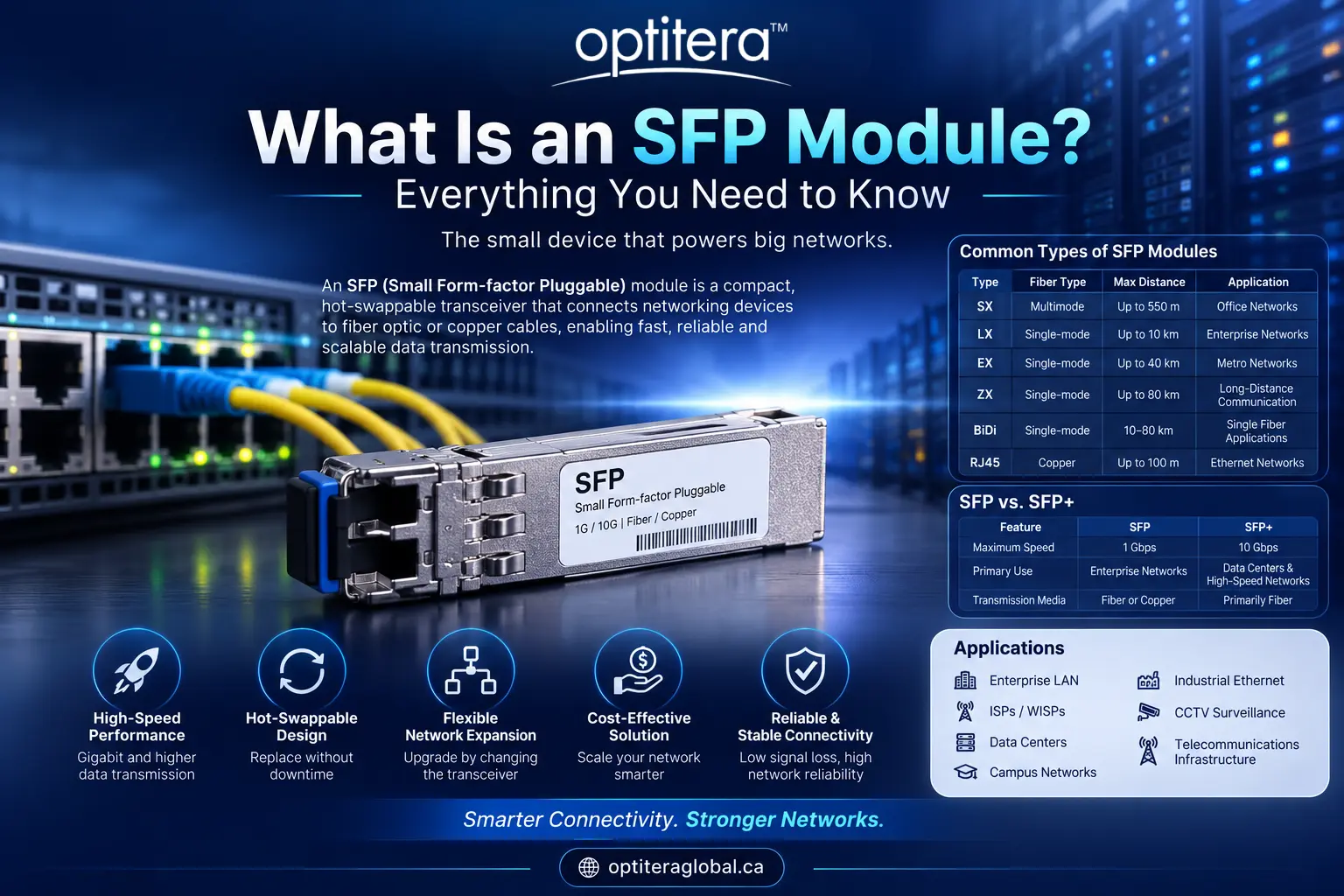
An SFP (Small Form-factor Pluggable) module is a compact, hot-swappable transceiver that connects networking devices such as switches, routers, firewalls, servers, and media converters to fiber optic or copper network cables.
Its primary function is to convert electrical signals generated by networking equipment into optical signals for transmission over fiber optic cables. At the receiving end, another SFP module converts those optical signals back into electrical signals, enabling high-speed communication between devices.
Unlike fixed network interfaces, SFP modules can be installed or replaced without shutting down the networking equipment. This flexibility allows businesses to upgrade or expand their infrastructure without replacing expensive hardware.
How Does an SFP Module Work?
An SFP module acts as the communication interface between networking equipment and the transmission medium.
When data leaves a switch or router, the transmitter inside the SFP module converts electrical signals into optical signals using a laser or LED. These signals travel through a fiber optic cable to another SFP module, where a photodetector converts them back into electrical signals that the receiving device can process.
This technology provides reliable, high-speed data transmission over both short and long distances while minimizing signal loss and electromagnetic interference.
Common Types of SFP Modules
Different networking applications require different SFP modules. Selecting the correct module depends on transmission distance, fiber type, and network speed.
| SFP Type | Fiber Type | Maximum Distance | Typical Application |
|---|---|---|---|
| SX | Multimode | Up to 550 m | Office Networks |
| LX | Single-mode | Up to 10 km | Enterprise Networks |
| EX | Single-mode | Up to 40 km | Metro Networks |
| ZX | Single-mode | Up to 80 km | Long-Distance Communication |
| BiDi | Single-mode | 10–80 km | Single Fiber Applications |
| RJ45 SFP | Copper | Up to 100 m | Ethernet Networks |
SFP vs. SFP+
Although they share the same physical form factor, SFP and SFP+ modules support different network speeds.
| Feature | SFP | SFP+ |
|---|---|---|
| Maximum Speed | 1 Gbps | 10 Gbps |
| Primary Use | Enterprise Networks | Data Centers & High-Speed Networks |
| Transmission Media | Fiber or Copper | Primarily Fiber |
Organizations planning future network expansion often choose SFP+ modules where higher bandwidth is required.
How to Choose the Right SFP Module
Selecting the right SFP module helps ensure reliable performance and compatibility with your networking equipment.
Consider the following factors before making a purchase:
- Choose the correct network speed (1G, 10G, or higher).
- Verify whether your network uses single-mode or multimode fiber.
- Select a module that supports the required transmission distance.
- Confirm connector compatibility, typically LC for fiber applications.
- Check compatibility with your switch, router, firewall, or media converter.
- Consider environmental conditions for industrial or outdoor deployments.
Carefully matching these specifications reduces compatibility issues and improves network stability.
Applications of SFP Modules
SFP modules are widely used across multiple industries because of their flexibility and scalability.
Common applications include:
- Enterprise LAN networks
- Internet Service Providers (ISPs)
- Wireless Internet Service Providers (WISPs)
- Data centers
- Campus networks
- Industrial Ethernet
- CCTV surveillance systems
- Telecommunications infrastructure
Their modular design allows organizations to upgrade network capacity without replacing existing networking equipment.
Benefits of Using SFP Modules
SFP modules have become the preferred networking solution because they offer several important advantages.
High-Speed Performance
Support reliable Gigabit and higher-speed data transmission for business-critical applications.
Hot-Swappable Design
Modules can be replaced without powering down networking equipment, reducing maintenance downtime.
Flexible Network Expansion
Businesses can upgrade fiber links simply by changing the transceiver instead of replacing the entire switch or router.
Cost-Effective Solution
Organizations can extend the lifespan of existing networking hardware while reducing upgrade costs.
Long-Distance Connectivity
Depending on the module type, fiber connections can extend from a few hundred meters to more than 80 kilometers.
Frequently Asked Questions
Are SFP modules universal?
Not entirely. While many follow the MSA standard, some networking vendors require vendor-coded or compatible modules.
Can I replace an SFP module without turning off the switch?
Yes. Most SFP modules are hot-swappable, allowing replacement without shutting down the connected device.
What is the difference between single-mode and multimode SFP modules?
Single-mode modules support much longer transmission distances, while multimode modules are designed for shorter connections within buildings or campuses.
Which SFP module should I choose?
The correct module depends on your network speed, transmission distance, fiber type, connector type, and equipment compatibility.
Conclusion
SFP modules are an essential component of modern fiber optic networking, providing flexible, reliable, and high-speed connectivity for enterprise networks, ISPs, data centers, and industrial applications. Understanding the different SFP types, transmission distances, compatibility requirements, and deployment scenarios helps organizations build efficient and scalable network infrastructure.
At Optitera Global Networks, we provide high-quality SFP modules, fiber optic accessories, and networking solutions designed for businesses, system integrators, and telecommunications professionals. Whether you’re expanding an existing network or deploying a new fiber infrastructure, our team can help you select the right connectivity solution for your requirements.